Windows · Android · Early version

Broke'nt

A private budgeting and debt-recovery app for Canada.

It tells you what you can really spend, fits your debts into your paycheques, and rewards decisions that actually help. Everything stays on your device.

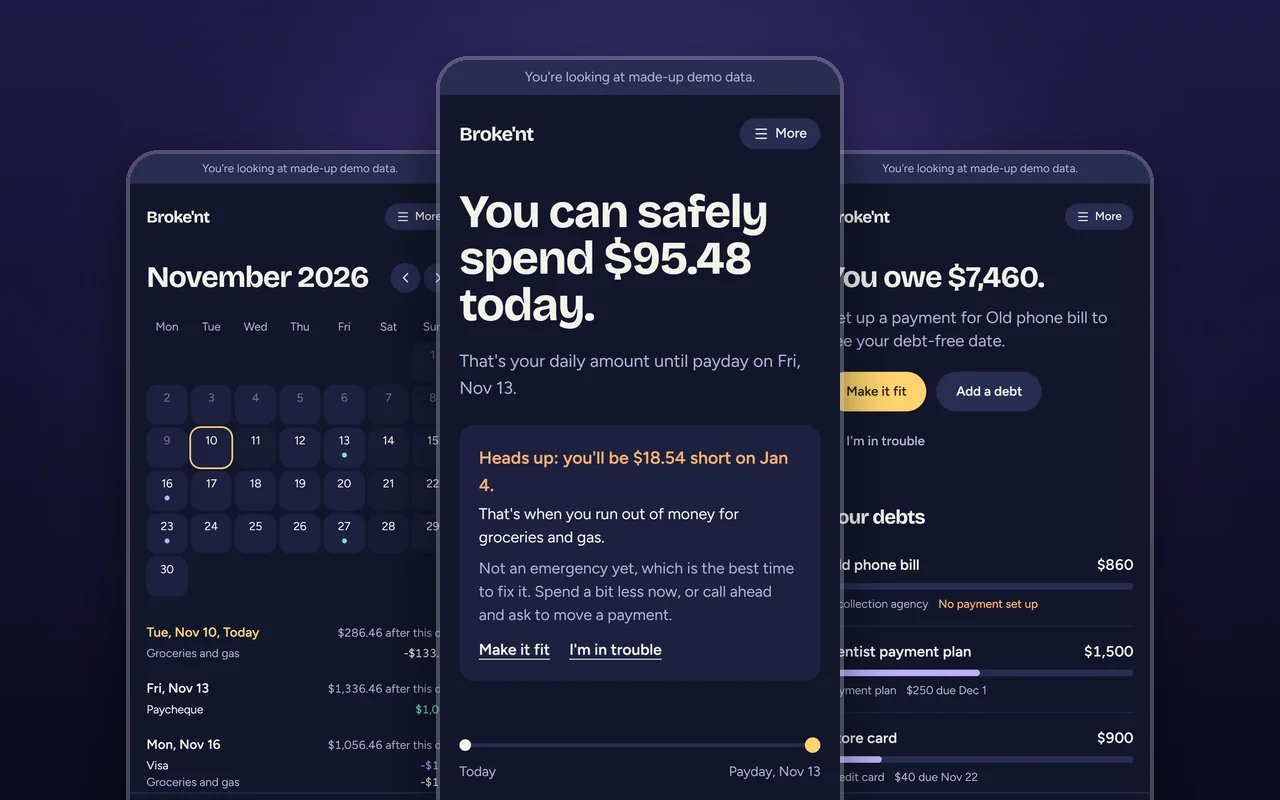
Three phone screens of Broke'nt with made-up demo data: a calendar, the home screen showing a safe amount to spend today, and a list of debts.
Platform
Windows and Android
Built with
TypeScript
Status
Early version (0.1.0)
Languages
English, French

What it is

Broke'nt is a private budgeting and debt-recovery app for Canada, in English and French. It tells you what you can really spend, fits your debts into your paycheques, and rewards decisions that actually help.

It's for people who are bad with money and want out of trouble. It isn't trying to help you invest or build wealth: every feature has to help someone stay afloat, get out of debt, or stop the next mistake.

Everything stays on your computer. There are no accounts, ads or subscriptions, and every bank connection is read-only, so the app can never move money.

Broke'nt is an early version (0.1.0). You can download the Windows installer below. It isn't code-signed yet, so Windows will warn you before installing, and the Android app isn't available to download yet. Still to come: testing on real phones and a native French review.

Download

Get Broke'nt.

This is an early version (0.1.0). Everything stays on your device: there are no accounts, ads or subscriptions.

  • Windows

Windows installer

A normal install wizard, about 124 MB. The installer isn't code-signed yet, so Windows SmartScreen will say it doesn't recognize it: choose More info, then Run anyway. Your data lives in your own app data folder, and uninstalling doesn't delete it. The installer doesn't update itself yet, so new versions are posted on the downloads page.

Download for Windows
  • Android

Android app

The Android app isn't available to download yet. It is a separate copy of Broke'nt that never needs your computer, and it will be posted here when it's ready.

Screenshots

Made-up data, real screens.

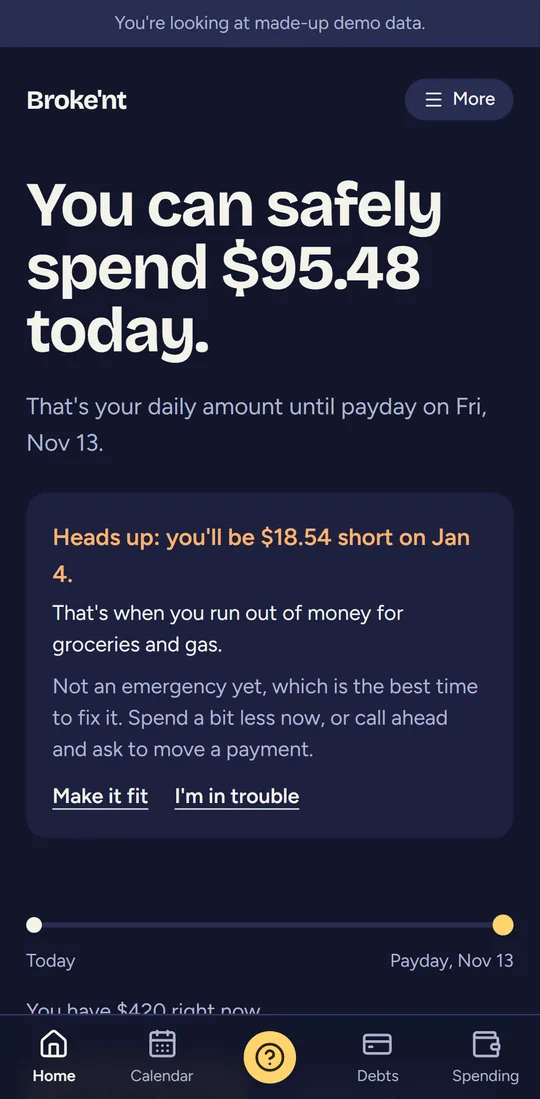
The Broke'nt home screen, with made-up demo data: a safe amount to spend today of $95.48 until payday, and a heads-up about being $18.54 short on January 4.
Home
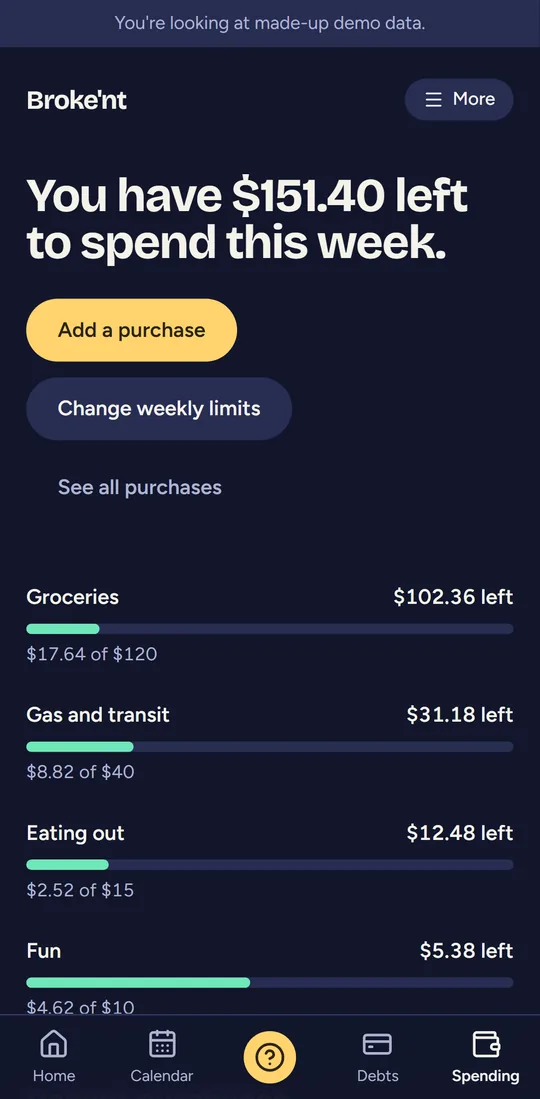
The spending screen: $151.40 left to spend this week, with weekly limits for groceries, gas and transit, eating out and fun.
Spending
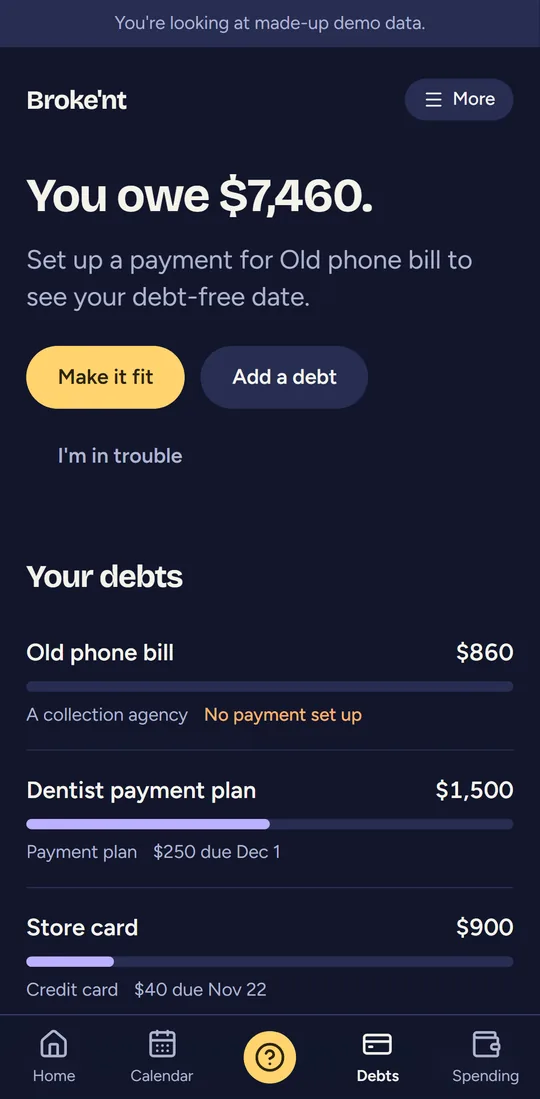
The debts screen: $7,460 owed in total, with an old phone bill, a dentist payment plan and a store card, each with a progress bar.
Debts
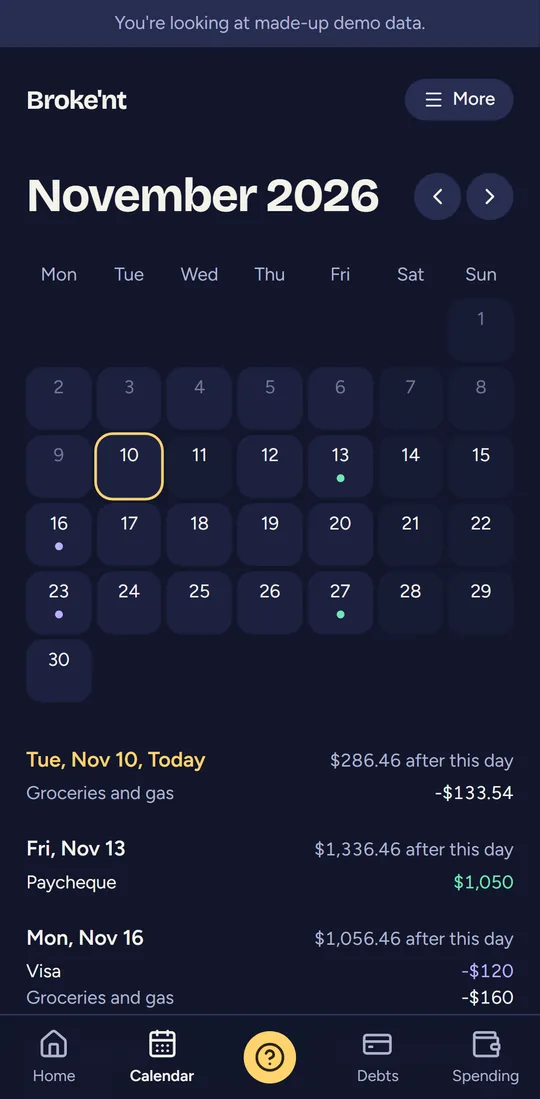
The calendar for November 2026, with the days that have bills or paycheques marked and the coming days' balances listed underneath.
Calendar
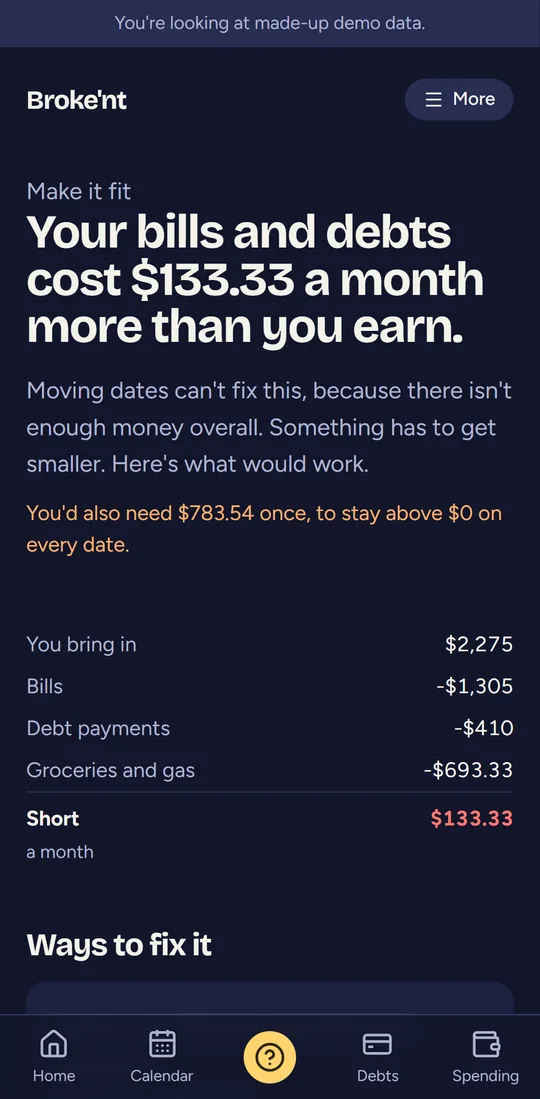
The Make it fit screen: bills and debts cost $133.33 a month more than is coming in, with the money in, bills and debt payments broken down.
Make it fit
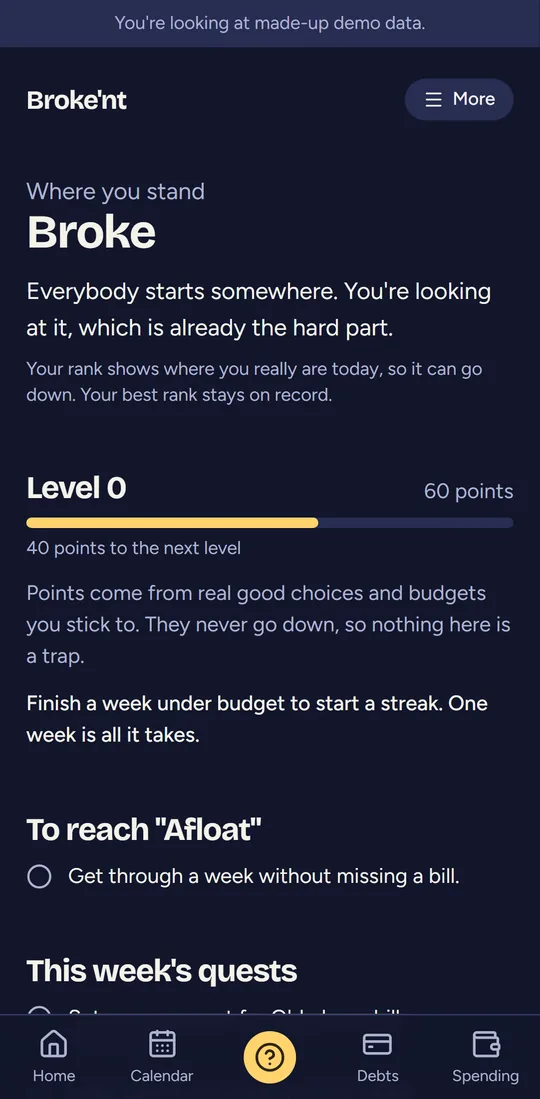
The progress screen: a rank called Broke at level 0 with 60 points, and a quest to get through a week without missing a bill.
Progress

Highlights

One question per screen.

Today's safe amount

What you can spend today and still make it to payday, after your bills and debt payments.

Can I buy this?

Yes, no, or yes with a trade-off, with the exact math. Type it the way you'd say it, like an $80 game this weekend.

Debts that fit your pay

Your existing debts fitted into your real paycheques, or the exact size of the gap and who to pay first.

Warnings before money runs short

A morning notification only when you're going to be short or a bill won't go through. Nothing when things are fine.

Private by design

Everything stays on your device. No accounts, ads or subscriptions, and bank connections are read-only.

Windows and Android

A Windows app that lives in the tray, and a separate Android app that never needs your computer.

English and French

Switch language any time. Every word on screen has a French version.

Rewards for real decisions

Points, badges and ranks for facing a debt, paying a bill or finishing a week under budget. They never go down.

Lessons and letters

Short lessons, and letters you can send in French or English that never admit an old debt.

How it works

From a pile of bills to one number.

  1. Get it all on the table

    Add your pay, your bills and your debts, including the old ones you've been avoiding.

  2. Get your bank data in

    Import a file from your bank, or connect SimpleFIN or Plaid. Every connection is read-only.

  3. See today's number

    Broke'nt shows what you can safely spend until payday, and warns you early if a shortfall is coming.

  4. Make it fit

    See whether your debts fit in your paycheques, and who gets paid first if they don't.

  5. Check in each week

    A two-minute weekly review keeps your plan honest and earns points for the right moves.

In detail

How it thinks.

Today's number

Broke'nt works out what you can safely spend today, until your next payday, after bills and debt payments. If you're heading for a shortfall it says so early, for example that you'll be $18.54 short on a given date, while there's still time to fix it.

It always errs on the safe side: the highest recent amount for a bill that varies, the lowest for pay that varies, and bills before income on the same day.

Can I buy this?

Ask before you spend and get a plain answer with the math behind it. You can type a purchase the way you'd say it, and Broke'nt works out what you meant.

Everyday spending isn't treated as a bill, and paying bills or debts doesn't use up your weekly limits.

Make it fit

It takes all your debts and fits them into your real pay, paycheque by paycheque. If they don't fit, it shows the exact size of the gap and who to pay first, instead of leaving you to guess.

The I'm in trouble button turns on hardship mode, which shows who gets paid first when there isn't enough for everything.

Help that follows Canadian and Quebec rules

It reminds you to check how old a debt is before you pay or promise anything, because old debts have special rules in Quebec. There's a rent-increase checker based on the tribunal's published rules, a winter heating fund, and a note on the winter no-cut rule for electric heating.

Letters you can send, in French and English, are written so they never admit an old debt.

Rewards that can't be faked

Points, badges and ranks come from real decisions: facing a debt, paying a bill, finishing a week under budget. Debts become bosses to beat.

Points never go down, so nothing here is a trap, and payments you type in by hand earn only half points so a made-up entry can't win you anything.

Getting your bank data in

Import a file from your bank's website (OFX, QFX or CSV), or a PDF statement from supported chequing accounts, read entirely on your own device. Or connect SimpleFIN or Plaid for background updates, or add Google Wallet on the phone so each tap to pay becomes a purchase.

Every connection is read-only. Importing a file is the fully private option, since no third party ever sees your transactions.

Privacy, backups and sync

Your data lives on your device. Bank tokens are encrypted, you can encrypt the whole database, and the app keeps daily backups. A password-locked backup file can go anywhere you like.

To keep a phone and a computer in step, each saves an encrypted copy in a folder you choose, such as one OneDrive, Dropbox, Google Drive or Syncthing already syncs. The folder never holds anything readable without your sync password.
Questions

Good to know.

Can I download it?

Yes, for Windows. The early version (0.1.0) is on the downloads page linked above. The installer isn't code-signed yet, so Windows will warn you, and it doesn't update itself yet, so new versions will be posted there. The Android app isn't available to download yet.

Is it open source?

Not at the moment. The code is in a private repository.

Can it move my money?

No. Every bank connection is read-only, and the app can never move money or pay bills.

Where does my data go?

It stays on your computer or phone. If you connect a bank through SimpleFIN or Plaid, that provider reads your transactions, which is the trade-off for a live connection. Importing a file keeps everything fully private.

Who is it for?

People who are bad with money and want out of trouble. Investing, wealth-building and shared household budgets are deliberately left out.

Is it only for Quebec?

It's built for Canada and works in English and Québec French. Some of the help, like the old-debt reminder and the rent-increase checker, follows Quebec rules.

Is it financial advice?

No. It does math and shows options. It isn't licensed financial, credit or legal advice.

Get Broke'nt.

Broke'nt is an early version (0.1.0). Download it for Windows, or have a look at the other projects.